Friday, 10 August 2012

Fairy wands and can guitars


The National Trust kids area was bursting with a whole load of natural colour and music at this years Holifair!


Throughout this 3 day family festival children showed off their creative sides making beautiful headresses and eye masks using natural hedgerow materials as well as fairy wands and rainbow sticks. The rainbow sticks certainly brought out the rainbows as we were treated to all 4 seasons in a day!


In the tipi, workshops enabled families to make musical insturments such as shell shakers, bamboo maracas and can guitars. We formed the first 'chicken soup band' on Friday as some guitar enthusiats played slide guitar on thier instruments made out of recycled food cans. There were also workshops in felting and making natural cordage from flax leaves or wool where colourful bracelets and felt shapes were carefully designed and woven into place.


Turning a piece of sycamore on the pole lathe


Inside the woodland glade families were able to try their hand at wood turning on a traditional pole lathe or make a gypsy flower by pairing down a hazel rod on a shave horse. All the wood was sustainably sourced from local Trust woodland and the lathes powered by foot! Meanwhile the glade was decorated as children painted the trees in an aboriginal style with paints they had made from natural materials such as beetroot and charcoal.


The Trust team thoroughly enjoyed being a part of Holifair again. The festival is environmentally friendly and raises funds to support the Holifield Farm Project at Gweek.

Elle

Wednesday, 1 August 2012

Time Travellers at Gunwalloe!

For the third summer running an excavation organised by the National Trust and funded as part of the Unlocking our Coastal Heritage Project is enabling archaeologists, local communities and visitors a unique opportunity to discover more about the history of this fascinating site. 

The project kicked off with a guided walk led by Dr Imogen Wood, an expert in the ancient history of Gunwalloe. We were lucky enough to see some of the artefacts she found during the previous years digs.

Dr Wood also showed us an artist's impression of what the area and the round houses might have looked like in the Bronze age.


The dig this year will focus on the promontory fort between St Winwalloe's Church and the open sea. The excavation began this week and so far a cow's tooth has been uncovered as well as some interesting charcoal layers in the soil. Students from Exeter University and local volunteers are carrying out the work on the fort which has captured people's imagination for hundreds of years but has never been investigated before.
 

You are welcom to talk to the people involved in the work and we warmly invite you to the Time Travellers open day event on Sunday 12th August from 11am-5pm. There will be children's activities, you can help to sift the soil and see the artefacts already uncovered. See you there.

Laura

Thursday, 19 July 2012

60 and never surfed?

Now the weather is starting to look a lot better why not try something new and exciting outdoors? Our event "60 and never surfed?" planned for the 1st and the 8th August is an introduction to surfing for those who've never tried it but want to give it a go. It's never too late to learn to take to the waves with our Ambassador Business the Dan Joel Surf School at Poldhu.


If you think you'd like to give surfing a go or want to get back into the water get in touch here for details. Although the half day event is aimed at those over the age of 60, we aren't that strict!


Layla

Slippery Poles and Sea Horses

Summer briefly appeared on The Lizard at the weekend for the annual National Trust Mullion Harbour Day.


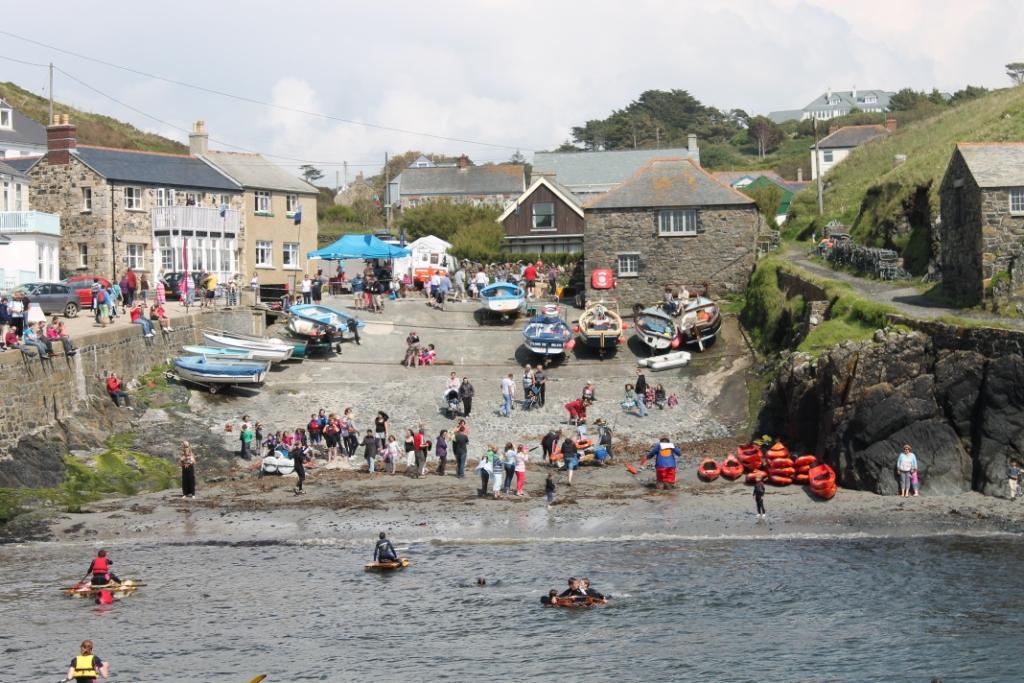
With a rare glimpse of sunshine at the weekend, hundreds of locals and visitors came down to Mullion Harbour for the annual Harbour Day. Working with our Ambassador Business, Lizard Adventure, they were treated to free taster kayak sessions, a raft race, harbour jumping, the "Sea Horse" Steeplechase (a run and swim whilst riding hobby horses made from discarded body boards) and the legendary "Greasy Pole" (pillow fights from a slippery pole jutting out over the harbour). Prizes for the games and races were kindly donated by local businesses. A hog roast and bar were provided to keep everyone fed and watered and stall holders set up shop around the harbour walls. The new RNLI Lizard lifeboat was on site and children's games and activities were provided in the marquee by our team of volunteers.

Jockeys prepare for the Sea Horse Safari Steeplechase / National Trust

Mullion's annual Harbour Day is organised by the Trust primarily as a community event, but it also raises much needed funds for the ongoing maintenance of the harbour itself. This year's event with the involvement of Lizard Adventure, meant we were able to offer much more of an 'outdoors experience' with kayaking and raft races. And with all the recent negative publicity regarding the dangers of 'tomb-stoning' and messing about in the sea, they also allowed the local kids the freedom to have a some serious fun in the safety of the harbour. As one young lad said, just before a particularly acrobatic fall from the greasy pole, "I've not had so much fun in years! They should have some of these activities at the Olympics."


mayhem and high jinks on the water during the raft race.....

A big thankyou to Elle and the rest of the Lizard ranger team, and the Lizard Adventure team for organising such a fantastic event.


...is that our old friend Trusty on a raft?


Justin

Wednesday, 18 July 2012

Lizard Wildlife Weekend

pole lathes on Lizard Green
We teamed up recently with our friends at Natural England, RSPB and the Cornwall Bird Watching and Preservation Society to host two days of fantastic fun for all the family at the Lizard Wildlife Weekend. Based on the Green at the heart of the Lizard village the event was a huge success with both local and visiting families.

On offer were a range of guided walks introducing the local wildlife, the highlights of which were seeing a young family of choughs near Kynance Cove, watching the peregrine falcon scour the cliffs, and finding some of the Lizard’s rarest plants such as fringed rupturewort and long-headed clover. 


Peering inside the owl box

There were other activities ongoing throughout the day such as green woodworking demonstrations, pond dipping, children’s nature crafts, owl pellet dissection and Cornwall’s very own premiere of  ‘Birchett-Swan’s Barn Owl Box Cinema’ , allowing visitors to peer inside the secret world of an owl nest box and watch recorded highlights.  Children and adults alike were mesmerised by the footage of owl chicks, recorded locally in nest boxes by naturalist Matt Birchett.


The chough bunting production line!
Along with the hustle and bustle of all the events, the atmosphere on the Green was vibrant thanks to live music from local musicians Emily Howard, Jonathon Coudrille, John Holden and Harry Rowland. The festival atmosphere drew in a wide range of visitors and kept people entertained all through Saturday. Unfortunately like many events this summer, bad weather curtailed activities so soggy conditions meant only a limited programme of events could be run on the Sunday.Well done to those intrepid families who braved the rain to go pond dipping with us!

For more information on all that happened at the Lizard Wildlife Weekend visit: www.cornishchoughs.org

Thanks to all who helped with this event.    Rachel and Rosie

Tuesday, 3 July 2012

Digging not so deep for history

The 18th Century round capstan stands at the back of Carleon Cove, beside the later Victorian factory showroom
 Visitors to Poltesco over the last few days will have been treated to a glimpse of the past, as archaeologists have been at work peeling back layers of history within the old capstan at Carleon Cove.


Recording the rediscovered bearing stone
 The work, undertaken by Southwest Archaeology, was commissioned to gain a better understanding of the buildings within the cove, particularly the substantial round stone tower which housed a capstan, or fishing winch, used to haul boats up the beach below. The capstan, dating to the 1700s, is the oldest building in the cove, and was once beside a square of pilchard cellars (like those still standing at nearby Cadgwith and Church Cove). The fishing cellars made way for the serpentine stone factory in the late 1800s which is now itself largely in ruins. The archaeologists were set the task of finding the bearing for the capstan as historians have speculated for many years as to whether it would still be there, and if so how deep it would be buried .

The stone shows a main socket and round wear marks
The answer was surprisingly simple. Yes there is a bearing stone in the centre of the building, and it was just a few inches down! The socket  to take a wooden upright is clearly visible, with a round wear mark formed from the turning of the winch. The capstan was probably turned by manpower, although it's conceivable that ponies or donkeys were used. The long since infilled gap in the wall which the ropes would have passed through to reach the beach is clearly visible on the seaward side.  As well as the bearing stone, some other interesting finds unearthed during the dig included metal brackets, old clay pipe stems, a shoe insole, and a brass button stud.


Whilst on site, the archaeologists have also been recording the exterior of the capstan, information which will help shape plans to undertake consolidation and repair work to the structure later in the year. We're grateful to the RDPE project which is funding both the archaeology and consolidation works. If you'd like to find out more about the fascinating history of Poltesco, join me for a guided walk on  Tuesday 17th July, meeting 1pm Poltesco carpark.


Rachel

Monday, 2 July 2012

Himalayan Balsam Blues


This week at Penrose we have been tackiling the problems of invasive plants. Our focus this time was Himalayan balsam. It is a relative of the busy Lizzie, but reaches well over head height, and is a major weed problem, especially on riverbanks and waste land, but can also invade gardens. It grows rapidly and spreads quickly, smothering other vegetation as it goes.

So whats the Problem? Each plant can produce up to 800 seeds. These are dispersed widely as the ripe seedpods shoot their seeds up to 7m (22ft) away. Once established in the catchment of a river the seeds, which can remain viable for two years, are transported further afield by water.


How do we control it? Plants that out-compete other more desirable plants or simply invade half the garden are classed as weeds and require control. First, we consider whether this can be done using non-chemical means such as pulling or digging out, or suppressing with mulch. If this can't be achieved, we would consider using chemical methods. But as they are easy to pull from the ground due to shallow roots we decided to manually remove them from the site. And as you can see below even Noodles the dog leant us a paw.


If you are interested in Volunteering on the Lizard or at Penrose please email me at gregory.cross@nationaltrust.org.uk

Greg


Contact us

Name

Email *

Message *