Friday, 7 February 2014

Mullion Harbour Update

Massive waves pounding the harbour walls January 2014
Cornwall has been witnessing an unprecedented number of storms, coupled with some of the highest tides of the year, over the past few weeks and, like many other settlements, harbours, cliffs and beaches around our coast, Mullion Cove has taken a severe battering.
Stormy seas coupled with high tides Feb 2014

Wednesday, 29 January 2014

Sand dunes; unsung heroes of coastal defence


Visitors to Poldhu Beach might be shocked to discover that much of the sand has disappeared following the storms and high seas at the beginning of January, unveiling a very stony beach and lots of beach litter.  Thanks to Friends of Poldhu, the litter has all been removed, but it will take months, if not years, for the sand to re-appear.  Fortunately, the sand hasn’t gone too far, as any local surfers will be aware, there is now a rather useful sandbar just offshore, creating a tidy right hand break. 


When I first came to the Lizard 20 years ago, it was common for local farmers to quite legally remove sand from the beach.  This ancient right ‘for the betterment of the land’ probably started with a farmhand with a shovel and horse and cart.  By the 1990s, there were regularly fleets of trucks on the foreshore being loaded up by JCB, an unsustainable practice which was fortunately stamped out in 2007.  


Whilst the beach itself has lost much of its sand, the dunes behind the beach have remained remarkably unscathed.  The dunes at Poldhu are designated as a Site of Special Scientific Interest (sssi).  They are an amazing ecosystem, not just rich in wildlife but they also provide an incredibly useful natural defence mechanism against the ravages of storms and high winds. 


The highly specialised marram grass, tolerant of salt, wind and drought, binds the dunes together with a network of tough exploratory roots, allowing the further colonisation of other specialist species until the dunes become more stable.  Windblown sand, which would otherwise be lost from the beach, is trapped amongst the vegetation, and the dunes continue to grow.  Rare and unusual plants such as sea knot grass and sea holly grow amongst the grasses.


The rare ‘sea knot grass’ (Polygonium maritium) growing amongst the dunes


The Poldhu dunes however haven’t always been so healthy.  Until the late 1980s, cars were permitted to park on the beach.  In 1987, the National Trust embarked on a dune stabilisation project.  With cars banned from the beach, with areas temporarily fenced off, marram grass was planted and timber posts were installed to assist with the trapping of sand. 


Over 25 years later, the dunes are healthy, thriving and full of wildlife.  What the recent storms have proven is that they also provide a remarkable natural sea defence, protecting the road, bridge and car park from the ravages of winter storms.


A busy day on the beach (date unknown; any ideas?)


Sand dune restoration project (circa 1987)

  - Justin

Monday, 20 January 2014

We are upgrading!

For those of you who've visited Kynance Cove in the last few years you may have noticed recently that the toilet block and car park huts are looking a little worn out and in need of updating so we've put together a new plan for those buildings. 

How the car park looked back in the 80s
Kynance car park was acquired by the Trust back in the 1980s and originally there were several buildings onsite in the car park area including a hotel. These buildings were later demolished as the National Trust concentrated on improving the landscape, the damage that erosion had caused around the upper areas of the car park and improving the visitor access to the beach. 

The Ex-Council toilet block


These days if you visit there's very little in the landscape at Kynance aside from the two car park huts and the old council toilet block. The Trust took on ownership and responsibility for the toilet block back in 2005 and since then we've worked hard to try and maintain them, however we'd like to be able to provide our visitors with better facilities. 

 Working alongside a local design firm, Boex of Porthleven we've come up with a solution. We aim to use recycled shipping containers to replace these buildings this year and provide new up to date toilet facilities and visitor information. The containers are designed to be entirely transportable units which can be lifted off site at the end of the tourist season to leave the car park landscape completely building free.

How the new visitor reception could look
 The aim is to utilise two 20ft containers that will sit in the position of the current facilities and huts. The project has been recently dubbed “Kybox” and is being led by Visitor Services and Enterprises Manager Layla Astley. “We were looking for a solution that would enable us to move buildings out of the car park each year and relieve the pressure on the landscape, the idea came when I was looking out to sea one day and realised how many cargo ships use the Lizard as an important landmark, it just seemed to fit perfectly.” 

How the new toilet block could look
Sam from Boex says “Working  closely with the  National Trust on the Kybox project has been a fascinating design journey, the project itself is going to be an exciting forward thinking challenge due to the environmental sensitivity of the area and the fact the facilities will be portable.  The key for us is to create facilities that will be iconic to Kynance Cove but sit sensitively within the landscape.”

The units that have been designed locally will also be fabricated in the Lizard area, using locally sourced materials where possible and combining this with the latest technology for renewable energy. 

If you'd like more information about the project please get in touch with us here at the office you can email or call us on 01326 561407. 


Kynance Cove

Layla 

Tuesday, 31 December 2013

Farmers for the Future

It’s not often that farms change hands but on the Lizard this year we've handed the keys to the farm gate over to two new farmers who are set to farm for the future on National Trust farms on the Lizard.

Tregullas - mainland Britain’s most southerly farm

At Tregullas, which falls between the Lizard village and the coast, the Amiss family (Nevil, Rona and their five children) arrived at the farmhouse in September having moved from a Council farm in Devon.

When the farm became available again, the Trust met with the local community and over the period of a year, asked them what they wanted to see happen to the land on their doorstep. A number of things came back; that wildlife, views and access were important; that people wanted to be able to buy local food and that a working farm was what was needed for the village. We really feel that Nevil and Rona have all the things needed to make the wishes of the community become a reality.
 
The Amiss family and sheep
They've come to Tregullas with sheep, Gloucester cattle, goats, ducks and chickens and a lot of good ideas. Already the farm feels more alive than it has over the last two years whilst we have been searching for a new tenant with ducks paddling out into the fields, goats and sheep bleating and cattle grazing the cliffs and fields around the lighthouse, making things right for the rare plants and chough that depend on these habitats.


In addition they've set up a crowdfunding appeal to raise money to kick start a vegetable growing business at Tregullas and need your support. Visit http://www.crowdfunder.co.uk/tregullas-farm to get involved - they are 80% of the way to succeeding as we write this article…..


Predannack and Teneriffe farms – farming for wildlife

On the west coast of the Lizard the Trust’s land is really important for wildlife, from the rocky outcrops supporting the Lizard’s rarest plants, to the heathlands of Predannack airfield and the maritime grasslands and cliffs of the coast.

The Trust has been managing this land for wildlife for the past 30 years but a lot of that has been done through short term agreements with neighbouring farms or by using our own animals. It wasn't until we were able to take on additional land at Teneriffe farm that we could make a viable business with adequate buildings to support a farmer and his family to manage this land for wildlife in the future.

Will Watson
We’re pleased to have given this tenancy to Will Watson, a local farmer who has been looking after some of ours and Natural England’s land in recent years and whose herd of North Devon and Dexter cattle are hardy and sure-footed grazers who will cope well with the weather and the terrain on the wild west coast.

Will and his partner, Nicola, have a real passion for the landscape and the wildlife of this area and this came across strongly in their application to us. They will be moving into the farmhouse later in 2014. As they settle into their business they will sell their excellent beef through the National Trust campsite at Teneriffe as well as to the local community.

Alastair


Wednesday, 18 December 2013

DIY Christmas at Penrose

Local people from in and around Helston came to the Stables on Sunday to make wreaths and willow stars and other Christmas decorations.
All the greenery was from Penrose, found in various places around Loe Pool, thanks to the Duke of Edinburgh group for cutting it for us!
The cafe was also open too serving Christmas cake and The National Trust also provided mince pies and mulled apple juice, so there was a lovely Christmassy atmosphere.
This is an annual event for all ages and really is good fun so look out on the blog listings for the same thing in 2014! MERRY CHRISTMAS! Rosie

Tuesday, 26 November 2013

Caring for the coast path


Lizard Head in the Spring

The south west coast path traverses 600 miles of the UK’s finest scenery. Walk the whole distance from Minehead in Somerset to Poole in Dorset and, with all those ups and downs, you will climb the equivalent of 4 times the height of Everest! Over half of the coast path is in the care of the National Trust, so naturally it features strongly in our work in the SW.

 Here on the Lizard the National Trust cares for more than 10 miles of this well-loved trail. Work can be divided into routine maintenance, such as strimming and keeping drains flowing, and larger improvement projects. In the summer months just keeping on top of the strimming is a never ending task, tackled by staff, our regular volunteers, and contractors called in as reinforcements. More sheltered sections of the path require up to 3 cuts per year. 


renovating a footbridge at Black Head
New boardwalk and stepping stones at Chynalls Cliff

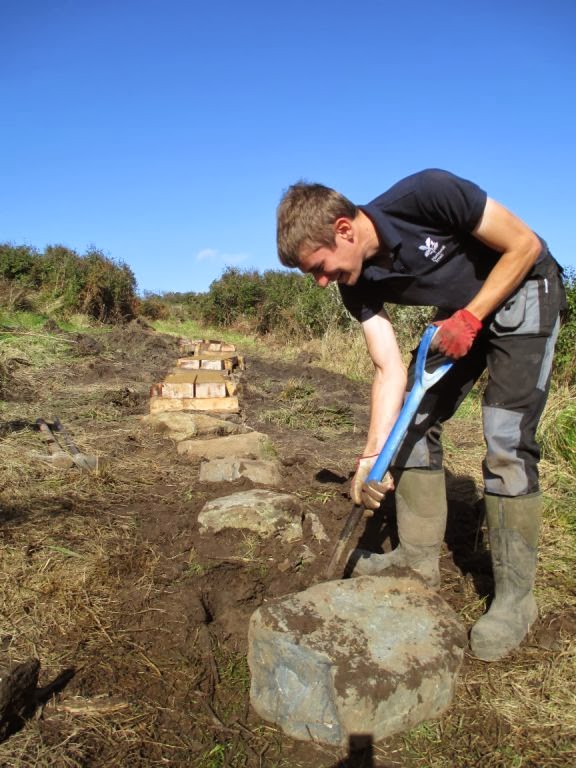
In recent times we have benefited hugely from two big investments in the path. Thanks to a very generous single donor, we have been able to employ an Access Ranger for most of the last 18 months, and this role will continue into 2014. Working together with our volunteers, the Access Ranger has allowed us to take huge strides forward in bringing structures such as steps, bridges and stiles up to a consistent standard.

Running in tandem with our Access Ranger’s work, has been a series of larger scale projects undertaken by contractors.  Many of these improvements have involved mini-diggers and other machinery, to bring about long-term solutions to sections that have been a recurring headache. Hopefully the days of repeatedly infilling gulleys on the steep hill above Poltesco are behind us, now that new larger cross drains have been installed, made of local serpentine stone. 8 different footpath projects have been completed by contractors on NT land on The Lizard in the last year, investing over £15000 in the coast path.

contractors re-profiling a stream crossing to reduce flood risk

Tasks have included rebuilding collapsed revetments, widening narrow and awkward sections of path, and making drainage fit to cope with heavier rainstorms. The majority of this funding has come from the Rural Development Programme for England, and the South West Coast Path Association, and we acknowledge their help in pushing forward these welcome improvements.

There’s never been a better time to get out and explore our coast on foot!

Rachel

Tuesday, 12 November 2013

Polpeor Update

10 tier scaffolding!
Cliff stabilisation work is progressing well at The Most Southerly Point, with the contractors on track to complete by Christmas. As you can see it has involved a mammoth scaffolding project, to provide the workforce with a safe means of accessing the cliff face. The scaffolding company exhausted their reserves on this huge job, and had to go shopping in order to get enough poles, planks and clamps to finish the structure!

Next stage, which started today, is drilling 24 2 metre deep holes into the cliff face, in order to insert pins and peg down stabilising mesh. This is done with an industrial scale drill run off compressed air, with water to flush out the debris. Machinery the workforce is very familiar with, as they all started their working lives deep underground as Cornish miners.

drilling 2m holes for stabilising pins
Drilling should largely be complete this week, with rolling out the mesh being the next step.  Early indications from the engineer are that the line of granites at the top will need to be pulled back from their present position by 1-2m to provide a safe margin to the new cliff edge. We believe this won't dramatically impact on access for vehicles or pedestrians to the Point itself, and once the soil has been returned and the grass recovered, the place will feel much as it did before the slip.
We'll keep you posted with the latest updates.

Rachel

Contact us

Name

Email *

Message *